Schemline is an AI-driven optimization engine for analog ICs — built to fit your existing flow, not replace it. Bring your schematic (Xschem import included), declare the spec, and Schemline sizes and certifies the design across all 6 process/voltage/temperature corners.
Schemline is an optimization engine, not a CAD replacement — it plugs into the flow you already have.
Start from a schematic you already have — hand-built, imported from Xschem, or drawn from scratch in Schemline’s own editor. No migration, no rewrite: Schemline reads the circuit as it is.

Tell Schemline AI the target in plain language — gain, bandwidth, phase margin, quiescent current. It detects the topology and plans the optimization; you never touch a solver setting.
Schemline resizes the circuit and re-checks every spec across all 6 process, voltage, and temperature corners — TT, FF, SS, SF, FS, hot and cold — until every cell in the matrix reads pass.
A walkthrough of the editor, ngspice simulation, and AI assistant on a real Sky130 design — end to end.
99% of hardware teams can’t afford professional analog design tools. The market has two extremes and nothing in between.
A complete design environment: schematic capture, ngspice simulation, and AI-driven optimization.
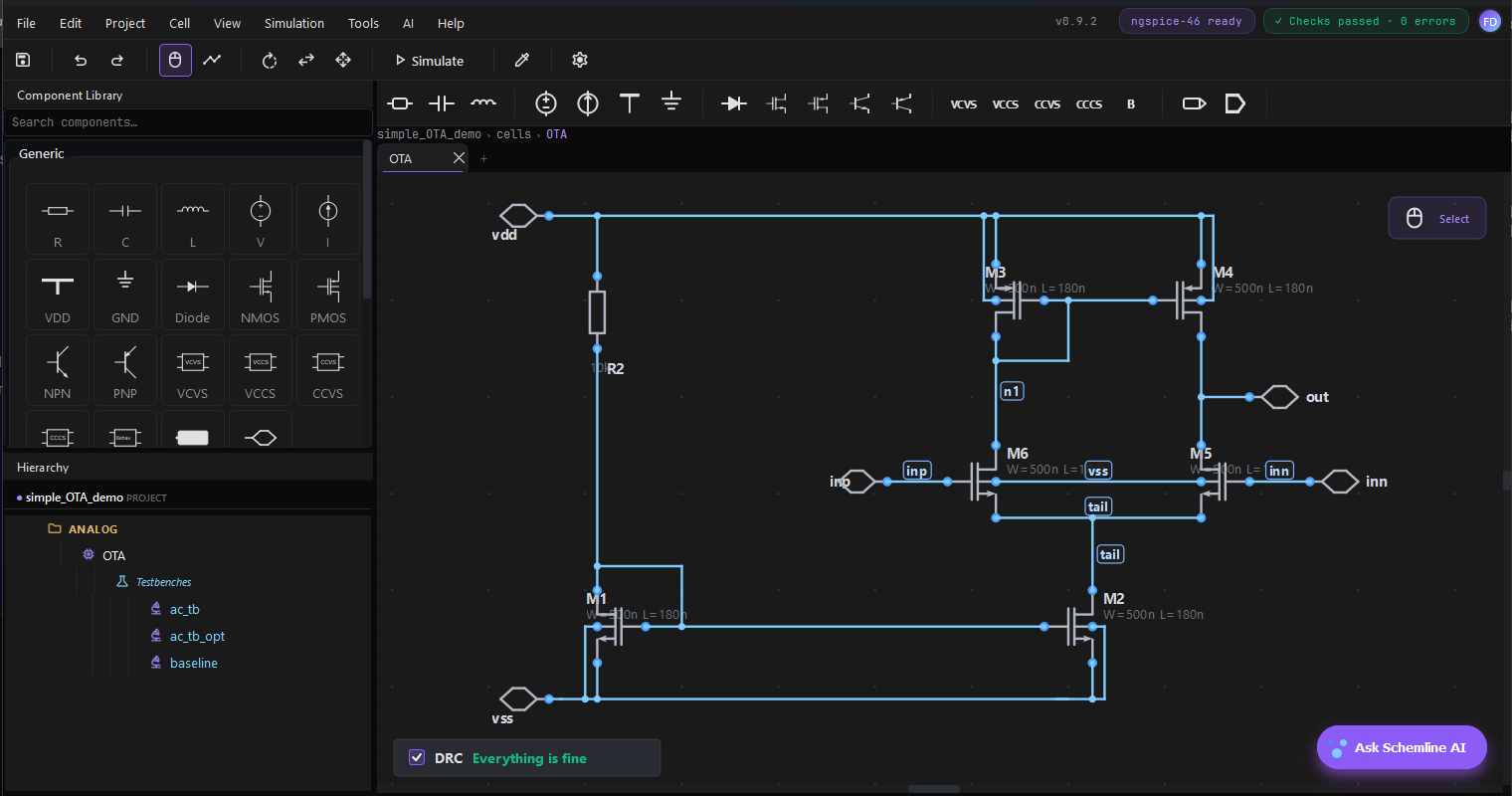
Virtuoso-style wire routing with Manhattan geometry, hierarchical subcircuits, and drag-and-drop from the Sky130 component library. Import existing Xschem schematics directly — hierarchy, orientation, and bus expansion preserved. Familiar to experienced designers, approachable for newcomers.

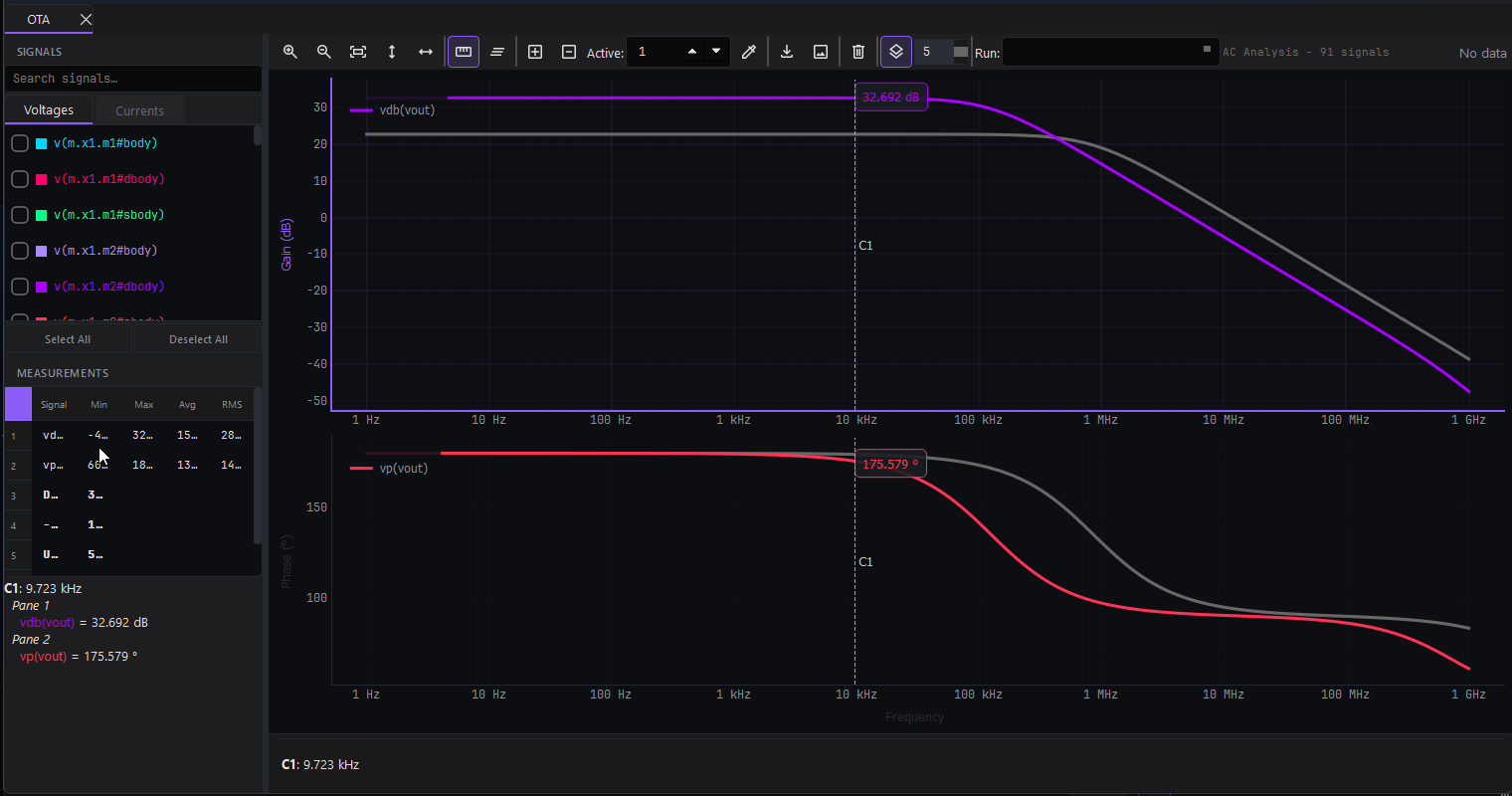
Persistent ngspice backend with batch execution for multi-run sweeps. DC, AC, Transient, Noise, Monte Carlo, corner, and parametric sweep analysis, all from one unified interface with binary rawfile parsing.

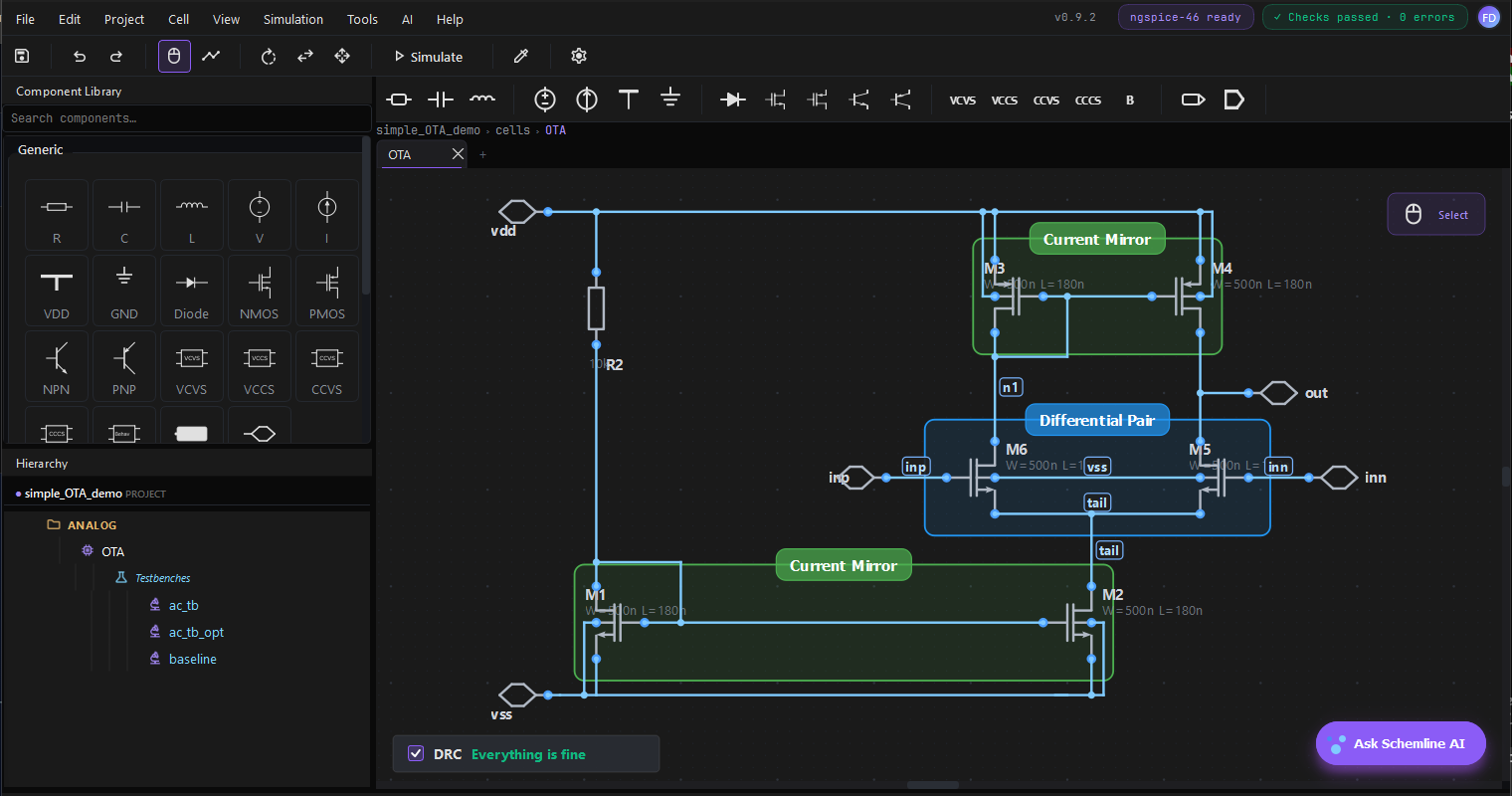
85 specialized tools orchestrated by an LLM. Topology detection, automatic testbench synthesis, coordinate-descent optimization. Type your specs and let Schemline AI do the job for you autonomously.
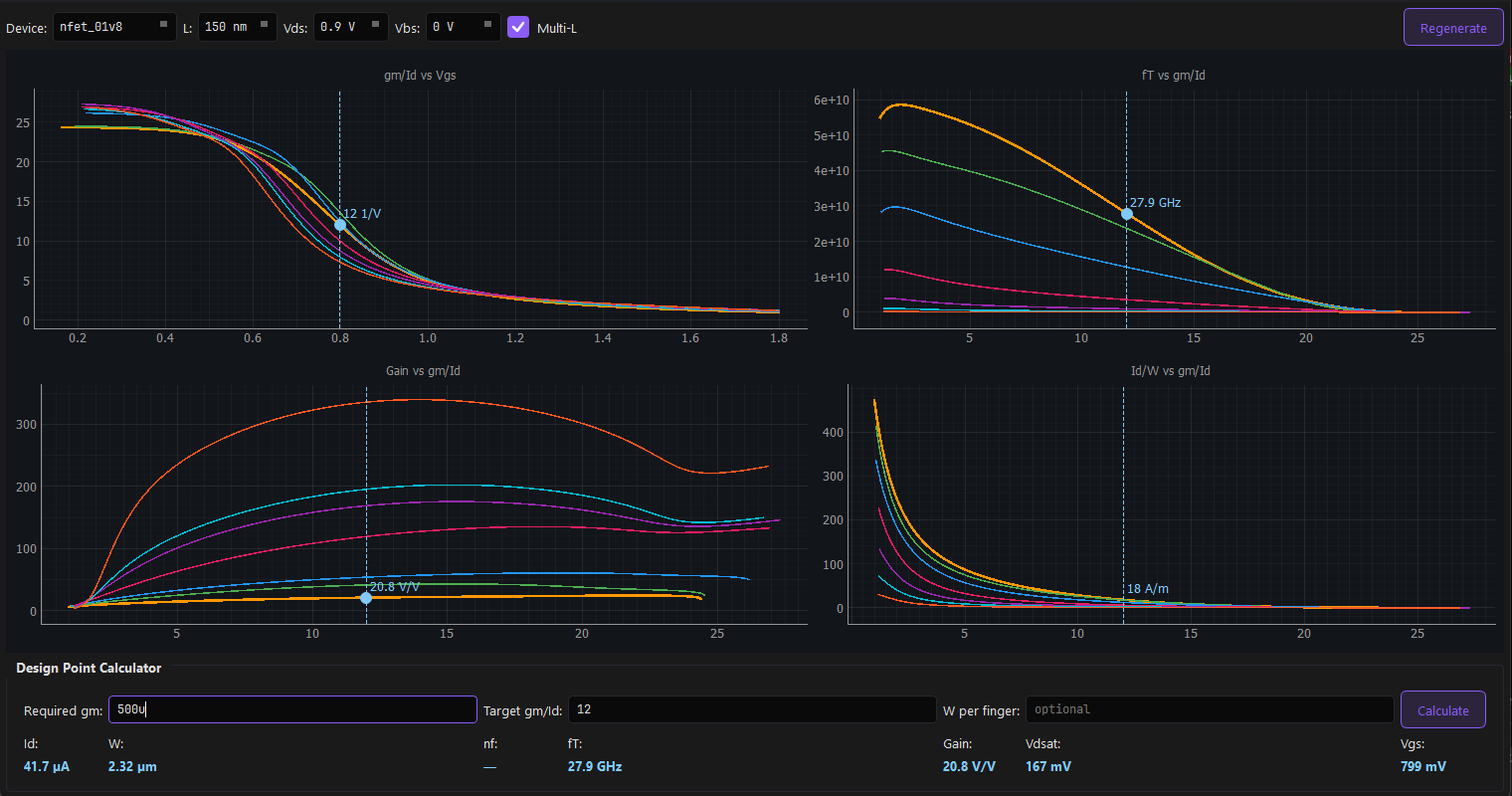
Native gm/Id methodology, not a plugin. Lookup tables, 4-panel visualization, and a joint multi-device solver that sizes matched devices — current mirrors, cascodes, differential pairs — together instead of one at a time. Every proposed change is checked against a physics-based gate before it’s applied to the schematic.

The features that matter for modern analog design.
| Feature | Schemline | Cadence | LTspice | Xschem |
|---|---|---|---|---|
| AI-Ready Architecture | ✓ Native | ✗ | ✗ | ✗ |
| Circuit Structure Recognition | ✓ Built-in | ✗ | ✗ | ✗ |
| gm/Id Methodology | ✓ Native | ⚠ Plugin | ✗ | ✗ |
| Xschem Schematic Import | ✓ Native | ✗ | ✗ | ✓ (native format) |
| Modern UI | ✓ Qt6 | ✗ Legacy | ⚠ Basic | ✗ |
| Cross-Platform | ✓ All | ⚠ Linux | ⚠ Windows | ✓ |
| Free for Academia | ✓ Free | ✗ | ✓ Free | ✓ Free |
| Monte Carlo / Corners | ✓ 6-corner | ✓ | ✗ | ✗ |
| Price | Free – €5k | €50k–200k | Free | Free |
98% of the analog EDA market is split between tools that are free but manual, and tools that cost €100k+/yr. Schemline captures the underserved segment in between with a three-tier SaaS model.
Final pricing set at launch. Global EDA software market: $12B+. Target segment: analog design tools, est. €500M.
Schemline is in private development ahead of a public launch. Reach out to discuss the technology, the market, or the roadmap.